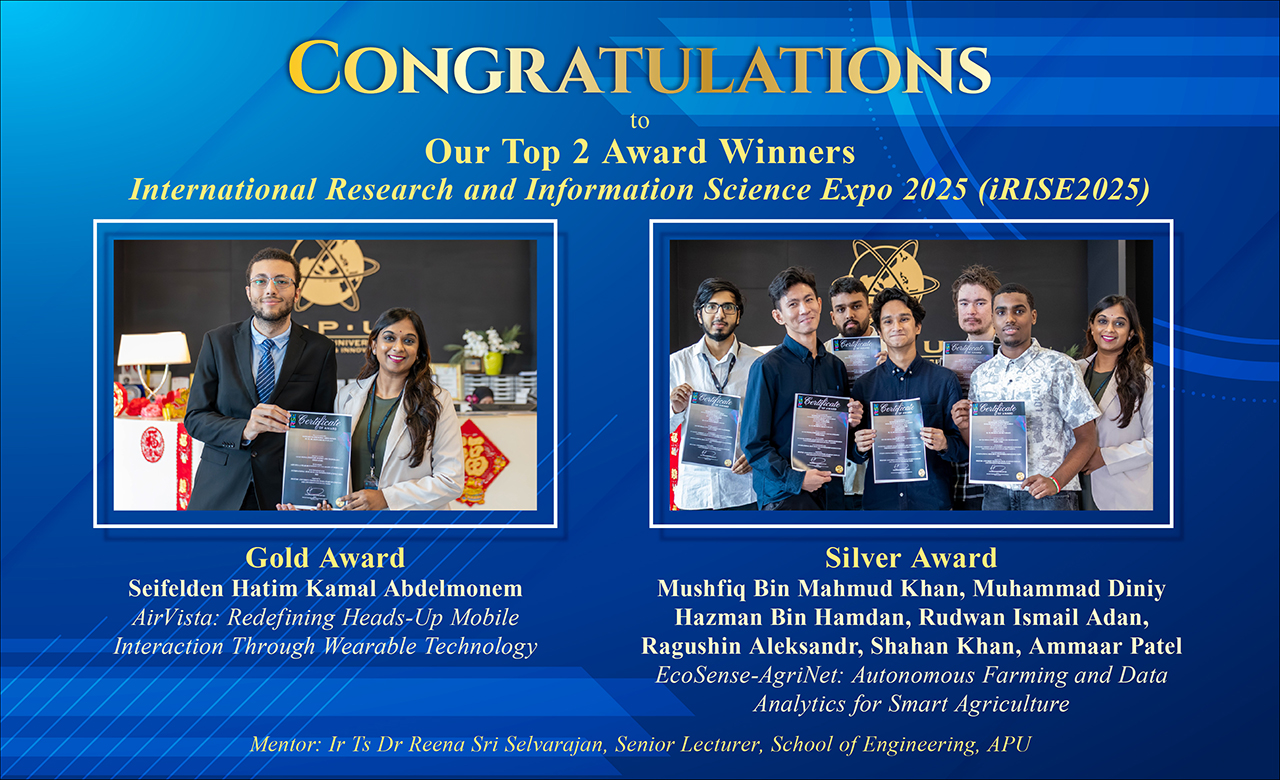
When curiosity meets structured mentorship and global exposure, innovation thrives. This was precisely the case for two purpose-driven projects from the School of Engineering (SoE) at the Asia Pacific University of Technology & Innovation (APU), which rose above 498 participants from across Asia to clinch two distinguished awards (Gold and Silver) at the International Research and Information Science Expo 2025 (iRISE2025).
Competing against entries from Malaysia, the Philippines, Indonesia, Thailand, Cameroon and beyond, APU’s Year-3 engineering undergraduates demonstrated not only technical ingenuity but also a mature, validation-driven approach to applied research—an achievement rarely seen at this stage of study.
Organised virtually by DIGIT360, a Universiti Teknologi MARA (UiTM) spin-off company, in collaboration with UiTM Kelantan Branch, iRISE2025 was held from 1 October 2025 to 15 January 2026. The competition culminated in a live-streamed award ceremony broadcast from UiTM Kelantan on 28 January, where APU’s students were announced as Gold and Silver award recipients among participants from institutions such as Montfort College (Chiang Mai), Universiti Malaysia Perlis, Universiti Tun Hussein Onn Malaysia and UiTM Shah Alam.
A Launchpad for Applied Research in Year Three
The two award-winning entries were developed under the mentorship of Ir Ts Dr Reena Sri Selvarajan, Senior Lecturer at SoE and module lecturer for “Communication Engineering Principles”. From ideation and conceptual framing to design refinement, validation and final presentation, Dr Reena guided the students throughout the entire innovation lifecycle.
“When I extended the opportunity to students within my module, these two teams stepped forward to transform ideas into tangible innovations,” Dr Reena reflected. “They exemplify initiative and intellectual courage. By choosing to begin their applied research journey in Year Three, they have set a powerful precedent for future cohorts.”
She further emphasised that such platforms provide invaluable exposure. “For the students, these projects marked the true beginning of their applied research and innovation journey. They were introduced early to international evaluation standards, interdisciplinary collaboration, and solution-driven engineering. This experience moves them beyond theoretical learning and places them within a global innovation ecosystem.”
Reimagining Mobile Interaction Through Wearable Technology
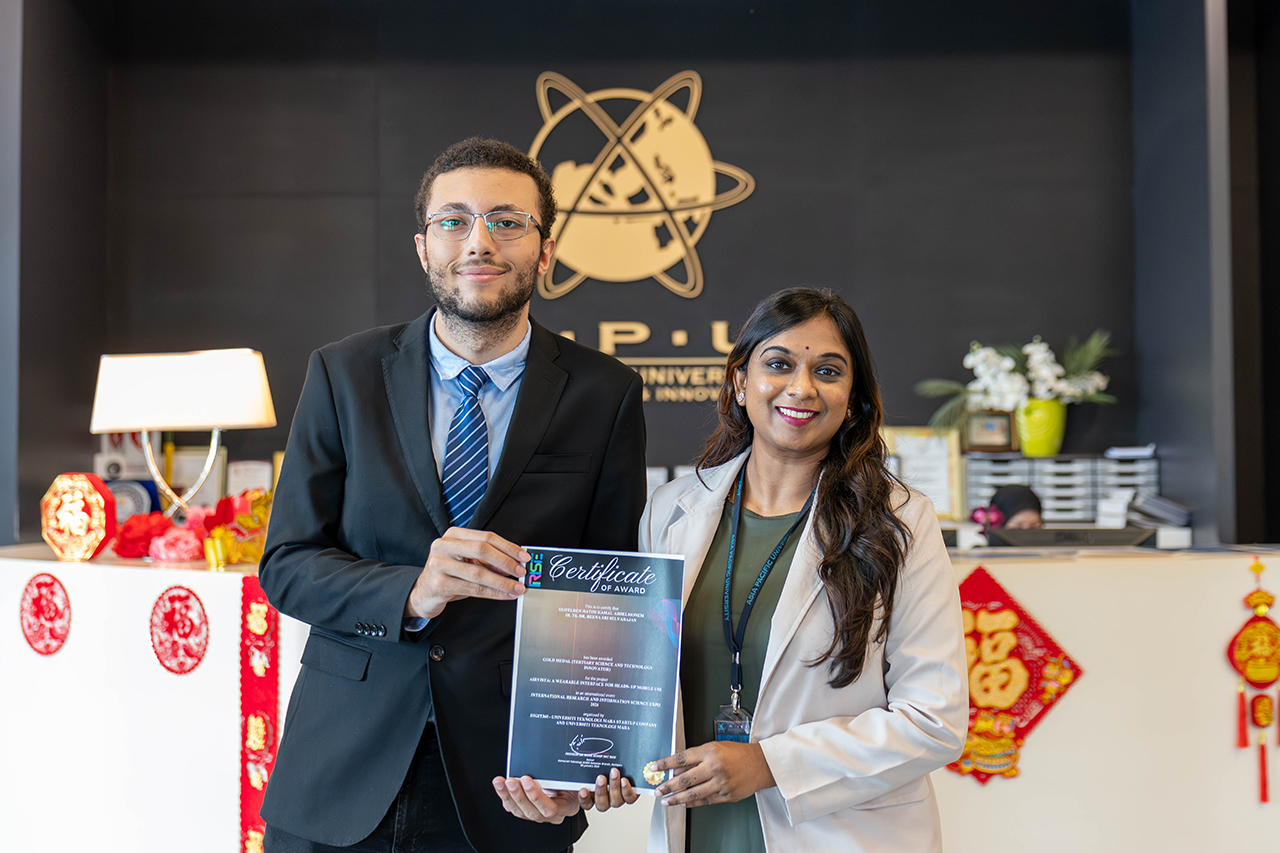
Mechatronics Engineering student Seifelden Hatim Kamal Abdelmonem secured the Gold award for his individual project titled AirVista: Redefining Heads-Up Mobile Interaction Through Wearable Technology.
AirVista introduces a wearable interaction concept designed to enhance mobile usability during everyday activities. By enabling hands-free, heads-up interaction, the system allows users to remain aware of their surroundings while accessing essential mobile functions. Addressing the risks associated with continuous screen dependency—particularly in mobility-intensive contexts—the project prioritises intuitive interaction and user safety.
Rather than remaining conceptual, Seifelden validated the system through functional demonstrations and structured technical reporting, ensuring the idea translated into a workable prototype with practical relevance.
“This experience has inspired me to continue developing solutions that genuinely enhance people’s daily lives,” Seifelden shared. “Competing internationally challenged me to think more critically about usability, feasibility and impact. I am deeply grateful to Dr Reena for her guidance and for encouraging me to take the first step in this innovation journey.”
Advancing Smart Agriculture Through Data and Automation
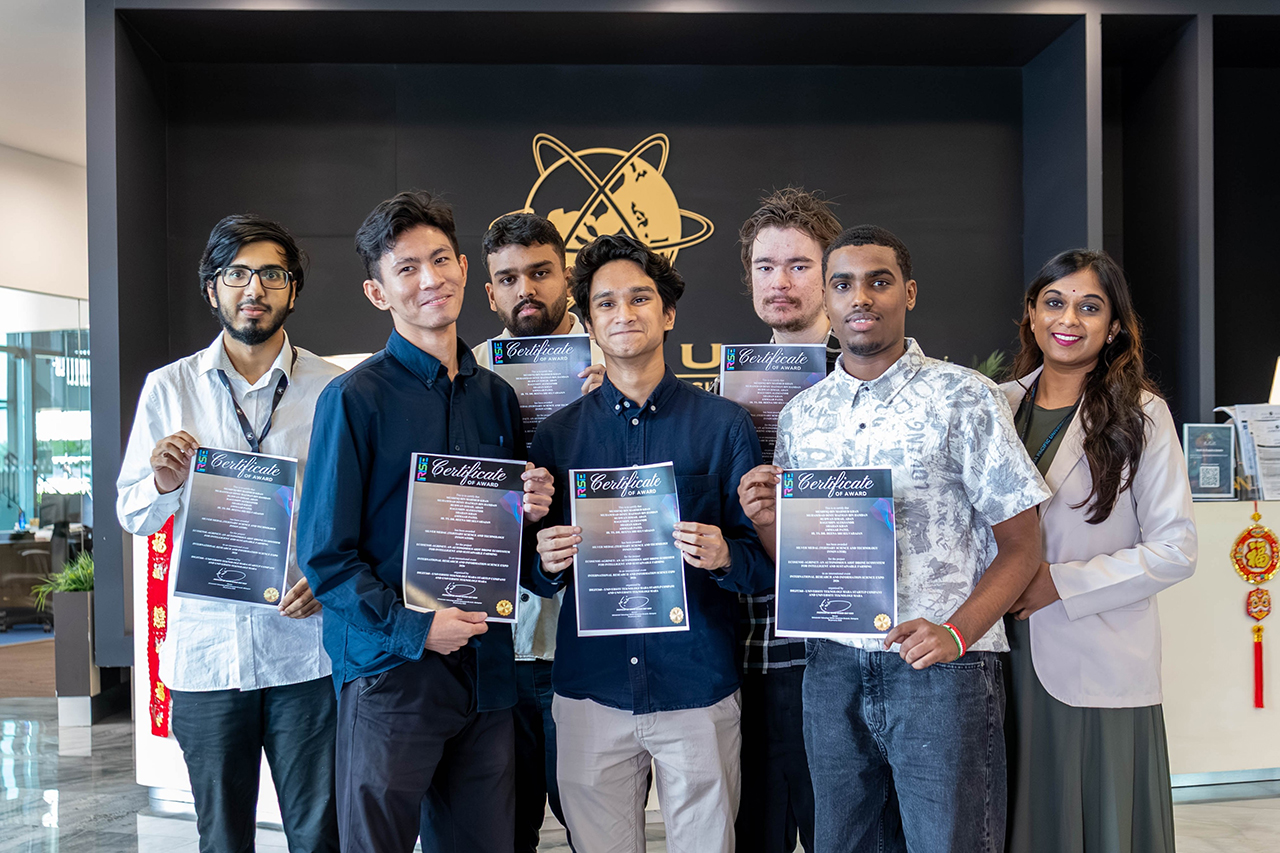
Securing the Silver award was a multidisciplinary team comprising Mechatronics Engineering, Electrical & Electronic Engineering and Computer Engineering students—Mushfiq Bin Mahmud Khan, Muhammad Diniy Hazman Bin Hamdan, Rudwan Ismail Adan, Ragushin Aleksandr, Shahan Khan and Ammaar Patel. Their project, EcoSense-AgriNet: Autonomous Farming and Data Analytics for Smart Agriculture, presented a forward-looking precision agriculture solution.
The system integrates data-driven monitoring with intelligent automation to support better decision-making in agricultural environments. Through real-time environmental insights and autonomous observation, EcoSense-AgriNet assists farmers in identifying crop conditions early, optimising resource utilisation and reducing reliance on manual intervention.
Strongly aligned with the United Nations Sustainable Development Goals (SDGs), particularly in agriculture and healthcare, the project demonstrates how Artificial Intelligence can be embedded into scalable, real-life applications addressing pressing societal challenges.
Ammaar Patel reflected on the learning process: “Participating in this competition taught us the true value of building a structured workflow and translating ideas into action within a clear project timeline. International evaluation required us to be rigorous, disciplined and solution-focused.”
He added, “Throughout the journey, we strengthened not only our research capabilities but also our critical thinking and problem-solving skills. We learned to communicate technical ideas clearly and validate our system’s real-world applicability. This experience has shaped us into more resilient, creative and collaborative engineers, ready to take on future challenges with confidence.”
From Concept to Credible Impact
A distinguishing feature of both projects was their validation-driven approach. The students did not stop at conceptual proposals; they refined, tested and communicated their innovations through comprehensive video-based technical reporting. By demonstrating functional relevance, usability and societal impact, they aligned their work with industry expectations and enhanced credibility on an international platform.
Dr Reena underscored the broader significance of this approach. “Engineering education must move beyond theoretical excellence to solution-oriented relevance. When students experience how their ideas evolve into validated outcomes, they begin to see themselves not just as learners, but as contributors to society.”
Together, the Gold and Silver recognitions at iRISE2025 underscore a powerful message: when curiosity, purposeful innovation and structured academic guidance converge, undergraduate projects can transcend the classroom and become meaningful contributions with real-world relevance.
For APU’s engineering undergraduates, this achievement is not merely a competition victory. It is the beginning of a lifelong journey in applied research, interdisciplinary collaboration and impact-driven engineering—one that demonstrates how early exposure to global standards can empower students to shape solutions for a rapidly evolving world.
News & Happening
Download e-Brochures
Intake Calendar
Want to know more ?
Let’s Connect