Recognition in the SciRank Global Scientist Index 2025 highlights the growing international influence of APU researchers across business, behavioural science, engineering, artificial intelligence and sustainability.
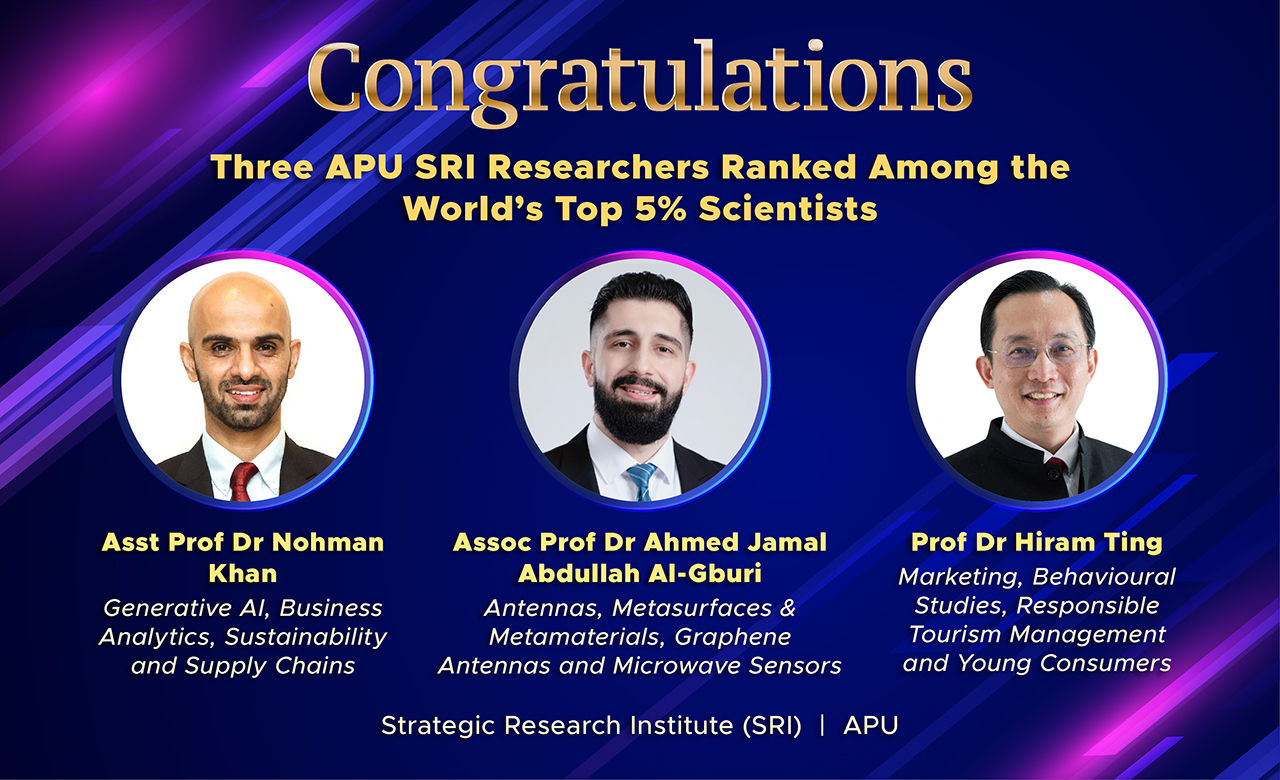
Asia Pacific University of Technology & Innovation (APU) has achieved another significant research milestone, with three academics from its Strategic Research Institute (SRI) recognised among the World’s Top 5% Scientists in the SciRank Global Scientist Index 2025.
The recognised researchers are Prof Dr Hiram Ting Huong Yiew, Assoc Prof Dr Ahmed Jamal Abdullah Al-Gburi and Asst Prof Dr Nohman Khan. Their inclusion reflects the sustained and growing influence of APU’s research across diverse disciplines, ranging from marketing and behavioural studies to engineering, artificial intelligence (AI), sustainability and supply chains.
Managed by SciRank Global, also known as the Institute of Scientometrics, the 2025 index assessed more than eight million active researcher profiles and 20 million scholarly works from over 150 countries before identifying the world’s top 5% of active researchers.
Scientist rankings generally consider factors such as the number and quality of published studies, how frequently those studies are cited by other researchers, and the consistency of a researcher’s scholarly contributions. Citations are important because they indicate that a study has informed, supported or influenced subsequent research.
Advancing Business and Behavioural Research
Prof Hiram advances APU’s research visibility in marketing, behavioural studies, responsible tourism, youth studies and Southeast Asian scholarship.
With 27,490 citations, an h-index of 57 and an i10-index of 118, his research has gained considerable international reach. His latest SciRank recognition reinforces his established position among the Stanford–Elsevier World’s Top 2% Scientists.
The h-index combines research productivity and influence. An h-index of 57 means that at least 57 of Prof Hiram’s publications have each been cited at least 57 times.
Meanwhile, the i10-index, developed by Google Scholar, counts the number of publications cited at least 10 times. These measurements help readers understand not only how much a researcher has published, but also how widely the work has been used by others.
Strengthening Engineering Innovation
Assoc Prof Dr Ahmed Jamal strengthens APU’s engineering research through his work in antennas, metasurfaces, metamaterials, graphene antennas and microwave sensors.
These specialised technologies can support advances in areas such as wireless communication, sensing systems, healthcare devices and next-generation electronic applications.
He has recorded 4,069 citations, an h-index of 37 and an i10-index of 109. His inclusion in the SciRank Top 5% adds to his earlier recognition among the Stanford–Elsevier World’s Top 2% Scientists, demonstrating the continued international relevance of his engineering research.
Expanding AI and Sustainability Research
Asst Prof Dr Nohman contributes to APU’s research in generative AI, business analytics, sustainability and supply chains—fields that increasingly shape how organisations make decisions, improve efficiency and respond to environmental and economic challenges.
He has accumulated 3,067 citations, an h-index of 27 and an i10-index of 48. His inclusion among SciRank’s Top 5% Scientists reflects the rapid international growth of his research profile and the expanding relevance of his work across academic and industry settings.
Building a Connected Research Ecosystem
The three academics work within a broader institutional environment designed to connect individual expertise with interdisciplinary collaboration.
Led by SRI Director Prof Dr Mohammad Falahat, the institute coordinates seven Strategic Research Clusters covering AI, business, social sciences, engineering, creative technologies, finance and education.
Image
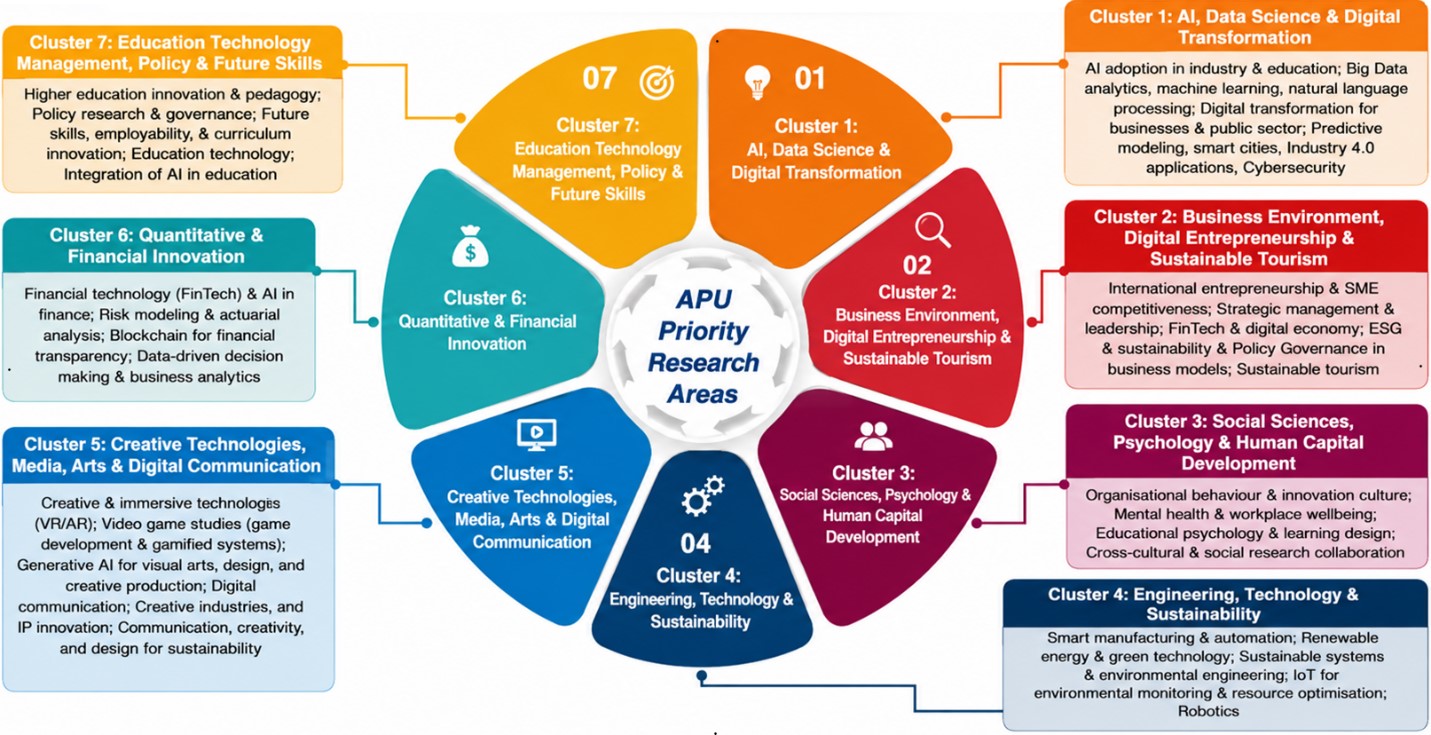
SRI brings researchers from APU’s different academic schools together through joint publications, competitive research grants, postgraduate supervision, international exchanges and industry-oriented projects. This approach positions APU’s campus as a living research environment where technological, economic and social challenges can be examined from multiple perspectives.
The institute has further strengthened this environment through research clinics covering publication strategies, scholarly originality, responsible AI and the development of meaningful research questions.
Such initiatives recognise that globally influential scholarship does not emerge from citation targets alone. It grows through mentoring, methodological discipline, collaboration and sustained engagement with real-world problems.
Rising Together on the Global Stage
The recognition comes during a period of wider advancement for APU. The university reached #528 in the QS World University Rankings 2027, its highest position to date, placing it among the world’s Top 2% of universities. APU also advanced into the 401–600 band of the Times Higher Education Impact Rankings 2026, which evaluates universities’ contributions towards the United Nations Sustainable Development Goals.
Scientist rankings and university rankings assess different dimensions of excellence. Nevertheless, both point in a consistent direction: APU is gaining greater global visibility while its academics build research influence across multiple disciplines.
The achievement therefore honours three outstanding SRI researchers without limiting APU’s research excellence to three individuals. Together with the university’s other internationally ranked scholars, they represent a research ecosystem that is becoming broader, more connected and increasingly visible to the world
News & Happening
Download e-Brochures
Intake Calendar
Want to know more ?
Let’s Connect