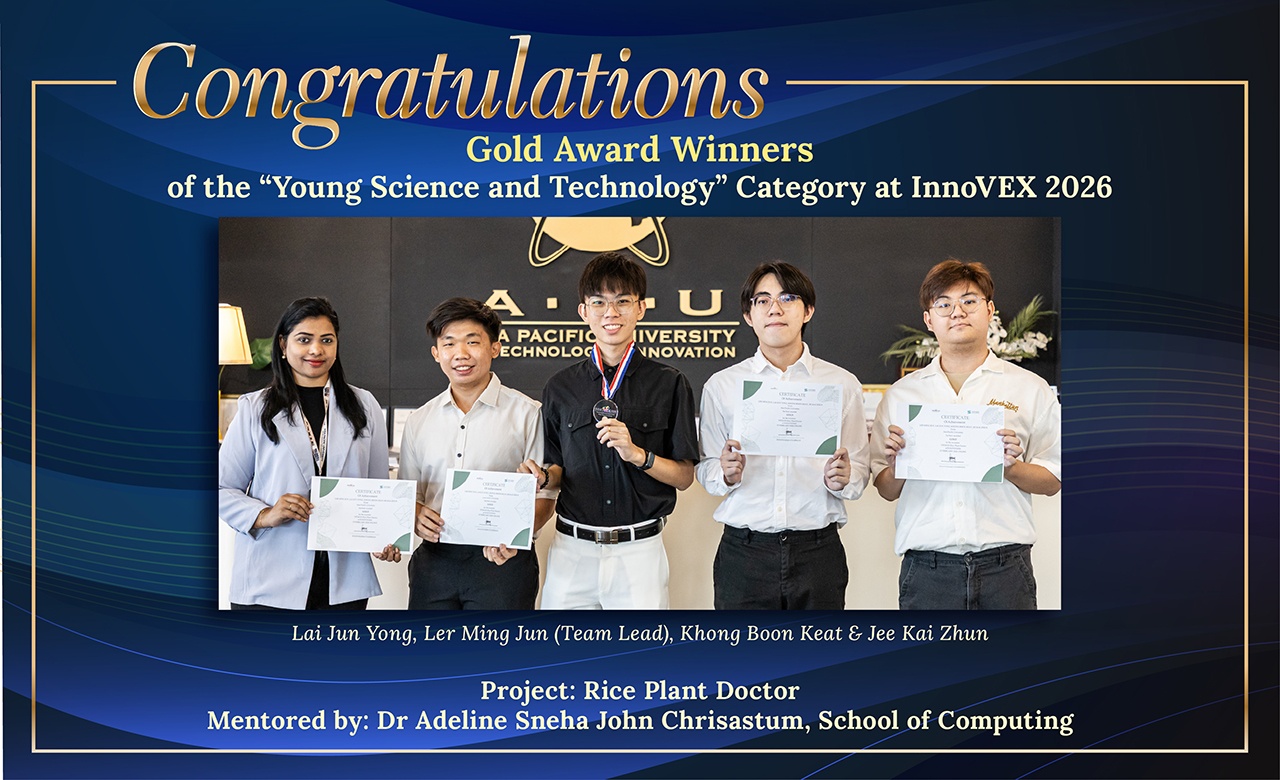
A team of undergraduate artificial intelligence students from the Asia Pacific University of Technology & Innovation (APU) has earned international recognition for their innovative agricultural technology project, Rice Plant Doctor, after securing the Gold Award under the “Young Science and Technology” category at the prestigious InnoVEX 2026.
The achievement highlights the growing role of young technology innovators in addressing real-world environmental and agricultural challenges through practical and sustainable digital solutions.
The award-winning team comprised Ler Ming Jun, Lai Jun Yong, Khong Boon Keat, and Jee Kai Zhun, all students pursuing the Bachelor of Computer Science (Hons) (Artificial Intelligence) degree at APU. The team was guided by Dr Adeline Sneha John Chrisastum, Senior Lecturer from the School of Computing, whose mentorship and technical supervision played a significant role in shaping the project’s success.
Rice Plant Doctor is a mobile-based application powered by artificial intelligence and computer vision technologies, developed to help farmers identify rice pests and diseases quickly and accurately in real time. By combining AI capabilities with smartphone accessibility, the project seeks to bridge the technological gap often faced by smallholder farming communities.
Organised by Innovation Excellence Ventures (IEV) together with the InnoVEX 2026 Secretariat, the competition concluded on 15 February 2026 and carried the theme “Empowering Innovation Beyond Limits.” The virtual competition attracted 239 participants from diverse academic and professional backgrounds locally and internationally, all presenting ideas and innovations aimed at promoting sustainability and addressing environmental concerns through technology-driven solutions.
Explaining the functionality of the project, Team Lead Ler Ming Jun shared that the application was designed with simplicity and accessibility in mind.
“By allowing users to scan crops via a smartphone camera or upload photos for analysis, the application simplifies the detection process. This is particularly crucial for smallholder farmers who may lack access to expert agricultural knowledge or stable internet connectivity,” he explained.
In addition to disease and pest detection, Rice Plant Doctor also features an AI farming assistant alongside integrated digital learning guides that provide farmers with educational support on crop treatments, prevention methods, and sustainable farming practices.
Beyond its technical innovation, the project reflects a strong commitment towards social responsibility and environmental sustainability. The students intentionally aligned their innovation with the United Nations Sustainable Development Goals (SDGs), particularly SDG 9 (Industry, Innovation and Infrastructure), through the modernisation of traditional agricultural practices using advanced AI technologies, as well as SDG 4 (Quality Education) by promoting continuous learning and digital upskilling opportunities for farming communities.
The project also demonstrates how undergraduate students can contribute meaningfully towards strengthening food security and supporting sustainable agricultural ecosystems through accessible technology solutions. By addressing challenges faced by farmers at the grassroots level, the team’s innovation illustrates the potential of youth-led technological development in creating long-term societal impact.
Dr Adeline praised the team’s achievement and their ability to apply artificial intelligence knowledge towards solving practical global issues.
“The success of Rice Plant Doctor at InnoVEX 2026 underscores the innovative potential of our students in developing meaningful, technology-driven solutions. Their work highlights how artificial intelligence can be effectively applied to agriculture, contributing to improved productivity, sustainability, and global food security,” she affirmed.
The accomplishment further reflects APU’s continued emphasis on nurturing future-ready digital talent capable of leveraging emerging technologies to address contemporary challenges, while contributing towards a more sustainable and inclusive future.
News & Happening
Download e-Brochures
Intake Calendar
Want to know more ?
Let’s Connect