Pathways
Using your SPM, ‘O’ Level or equivalent qualifications, you can progress to a wide range of internationally recognized degrees at APU in Malaysia via the APU Foundation Programme. Alternatively, you can enter the 2-year Diploma Programmes and enter directly into second year of Bachelor’s Degree.
With STPM, ‘A’ Level, UEC, IB or equivalent qualifications, you can enter immediately with first year. We offer degrees in Business, Human Resource Management, International Business, Tourism Management, Accounting, Banking & Finance, International Relations, Psychology, Marketing, ICT, Cyber Security, Artificial Intelligence, Technology, Software Engineering, Computer Science, Game Development, Design & Media, Engineering, Actuarial Studies, Visual Effects and many more, all the way to prestigious Masters & PHD degrees.
Delivered by well qualified faculty with extensive professional experience, we give you the solid base you require to obtain your dream degree.
Non-Engineering Pathway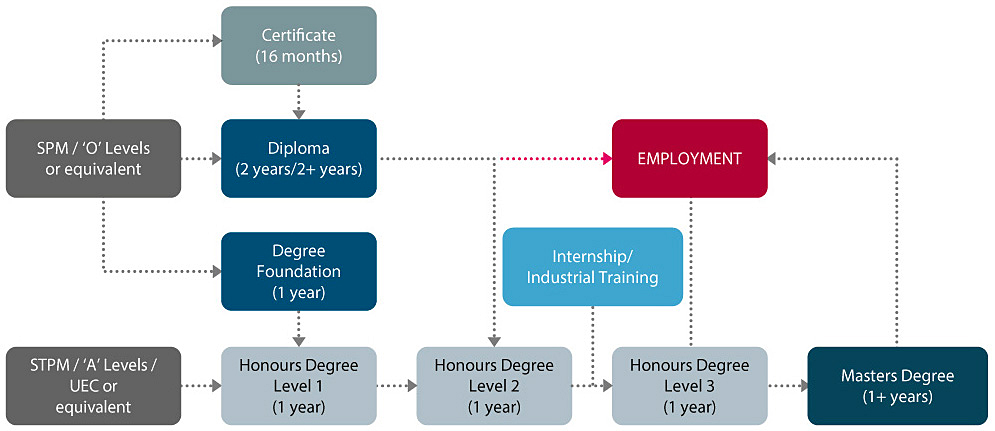
Engineering Pathway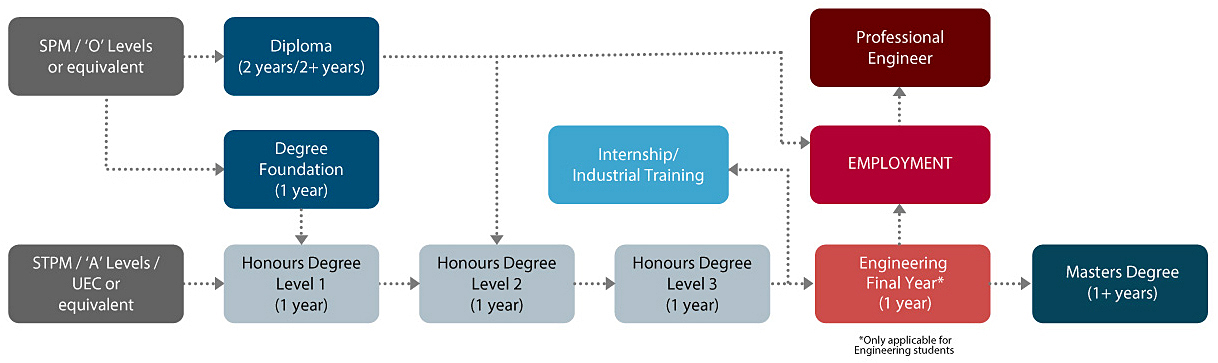
There are four routes:
-
BUSINESS, FINANCE & SOCIAL SCIENCES ROUTE

Business, Management, Marketing & Digital Marketing, Media and International Relations, Psychology, Hospitality & Tourism Programmes
Upon completion of your Foundation, you may then proceed to Level 1 of a Degree of your choice in the following pathways.
PRIMARY PATHWAYS ALTERNATIVE PATHWAYS
Students may alternatively choose the following:- Business, Management, Hospitality & Tourism
- Accounting, Finance, Banking & Actuarial Studies
- Media, Communication & Psychology
- International Relations
- Computing & Technology
- Immersive Technology & VR/AR
- Industrial Design, Visual Effects, Animation & Digital Advertising
- Architecture
- Game Development
SPECIALISED MODULES FOR BUSINESS, FINANCE & SOCIAL SCIENCES
Global Business Trends & Supply Chain
This module enables students to develop a broader understanding of global business patterns, emerging trends, and supply chain dynamics in identifying new opportunities. Students will examine how changes in society, demographics, technology, and global supply chain networks influence business strategies and operations. The module also explores current issues such as supply chain resilience, sustainability, and digital transformation, equipping students to respond effectively to the evolving global business environment.
Digital Business & Entrepreneurship
This module introduces students to the fundamentals of digital business and entrepreneurship in today's technology-driven economy. Students explore digital business models, e-commerce, innovation, entrepreneurial thinking, and the role of emerging technologies in creating business value. The module also develops problem-solving, opportunity recognition, and business planning skills while encouraging creativity, collaboration, and ethical decision-making to prepare students for further studies in business and entrepreneurship.
Further Mathematics
This module introduces students with mathematical knowledge and analytical skills essential for higher education. It fosters logical thinking, mathematical reasoning, and problem-solving abilities through the study and application of key mathematical concepts. The competencies developed in this module provide a strong foundation for undergraduate programmes in mathematics, actuarial science, computer science, business, and other quantitative fields.
Principles of Accounting and Finance
This module introduces foundation students to the fundamental principles of accounting and finance. It covers the complete accounting cycle, from recording transactions to preparing financial statements for sole proprietorships. Students also explore basic finance concepts, including financial management, sources of finance, financial markets, and the business environment, providing a strong foundation for further business and accounting studies.
Psychology & Behavioral Science
This module provides an understanding of the principles of behavioral sciences and how they apply to psychology. It will explore how environmental factors and individual experiences affect and shape human behaviors.
Global Citizenship & Cultural Intelligence
This module introduces the principles of global citizenship and cultural intelligence within international and business contexts. Students will develop an understanding of cultural diversity, global perspectives, ethical responsibilities, and cross-cultural communication. The module fosters adaptability, intercultural collaboration, and responsible decision-making, preparing students to engage effectively in international relations, global business environments, and multicultural communities.
Business Economics & Global Markets
This module introduces students to the fundamental principles of business economics and the operation of global markets. Students explore how economic concepts influence business decisions, consumer behaviour, market structures, international trade, and economic development. The module also develops analytical and critical thinking skills by examining contemporary economic issues and the impact of globalisation, enabling students to better understand the dynamic relationship between businesses, governments, and the global economy.
AI for Business and Design
This module introduces students to the application of Artificial Intelligence (AI) in business and design, highlighting how AI is transforming creativity, decision-making, and innovation across industries. Students explore AI-powered tools for content creation, design, marketing, customer engagement, and business analysis while developing practical skills in using AI responsibly. The module also encourages critical evaluation of AI-generated outputs and an understanding of the ethical, legal, and societal implications of AI in professional practice.
ELECTIVE MODULES
Discovering Media in the Digital Age
This module outlines communication methods, technologies, trends and approaches in the digital age. It includes the basic understanding of the various types and roles of traditional and new media industries. It will also cover the related institutions of journalism, advertising and public relations and their respective structure, support and influence in the digital media.
Cyberpsychology and Digital Society
This module introduces students to cyberpsychology and the role of digital technology in everyday life. Students will explore how people use and interact with digital technologies, and how these interactions influence behaviour, emotions, communication, relationships, learning, and well-being. The module introduces key issues in digital society, including responsible technology use, online safety, and digital citizenship. Through real-life examples, students will develop awareness of the psychological and social impact of technology.
Exploring Hospitality, Travel & Tourism
Discover the exciting world of hospitality and tourism by exploring the industry's core concepts, from accommodation and dining, to events and travel. Understand the industry's impact on the global economy and critically analyse industry challenges and trends, culminating the capacity to devise innovative solutions to complex problems.
Fundamentals of Risk Management
This module introduces the concepts and practices of risk management. Students will develop an understanding of how risks are identified, assessed, and managed across different industries. The module also introduces the role of actuarial science in analysing and managing risk, serving as a foundation for students who are interested in pursuing further studies in actuarial science and related quantitative fields.
Next-Gen Accounting Tech and FinTech
This module introduces foundation students to the evolving digital landscape of financial and accounting technologies. It explores the fundamentals of FinTech and Accounting Technology (AccTech), including digital payments, cloud accounting, artificial intelligence, blockchain, data analytics, cybersecurity, and financial innovation. Students will develop an understanding of how digital technologies are transforming accounting, finance, and modern business practices.
COMMON MODULES
English for Academic Purposes
This module develops English language proficiency for academic study through reading, writing, listening, and speaking skills. Students learn to critically analyse academic texts, communicate ideas effectively, and use academic writing conventions, including paraphrasing, summarising, referencing, and academic integrity. The module also develops the ability to evaluate and integrate relevant evidence to construct clear, well-supported academic arguments.
Personal Development and Study Methods
This module develops personal and academic competencies to support success at university and beyond. Students enhance self-awareness, emotional intelligence, leadership, critical and creative thinking, problem-solving, and decision-making skills while exploring personal well-being, career development, effective study strategies, and goal setting to become confident, adaptable, and lifelong learners.
Mathematics
Mathematics introduces the fundamental knowledge of mathematics and statistics. This module covers numbers, functions, equations and inequalities, indices and logarithms, probability and descriptive statistics. These concepts and techniques are essential for undergraduate study.
Public Speaking & Personal Branding
This module develops effective public speaking and personal branding skills for academic and professional contexts. Students learn to plan and deliver engaging speeches, communicate with confidence, and apply persuasive speaking techniques. The module also introduces strategies for building a positive personal brand, enabling students to present themselves professionally and communicate their strengths effectively.
Digital Communication & Collaboration
This module develops effective digital communication and collaboration skills for academic and professional contexts. Students learn to communicate clearly across digital platforms, collaborate productively in teams, and apply appropriate digital etiquette and professional practices. The module also enhances confidence in presenting ideas, sharing information, and using digital technologies to support collaborative learning and project work.
Research & Data Literacy
This module introduces fundamental research and data literacy skills for academic study. Students learn to locate, evaluate, and synthesise information from credible sources, interpret and present data, and apply basic research methods. The module also develops skills in academic integrity, ethical use of information, referencing, and effective use of digital resources for research.Upon completion of your APU Foundation, you may then proceed to Level 1 of a Degree of your choice in the following programmes:
- Bachelor of Arts (Honours) in Business Management
- Bachelor of Arts (Honours) in Business Management with a specialism in E-Business
- Bachelor of Arts (Honours) in Business Management with a specialism in Digital Leadership
- Bachelor of Arts (Honours) in Business Management with a specialism in AI & Business Analytics
- Bachelor of Arts (Honours) in Business Management with a specialism in Business Economics
- Bachelor of Arts (Honours) in Human Resource Management
- Bachelor of Arts (Honours) in Human Resource Management with a specialism in People Analytics
- Bachelor of Arts (Honours) in International Business Management
- Bachelor of Arts (Honours) in International Business Management with a specialism in Supply Chain Management
- Bachelor in Digital Marketing (Honours)
- Bachelor of Arts (Honours) in Tourism Management
- Bachelor of Science (Honours) in Hospitality and Tourism with a specialism in Hospitality Innovation
- Bachelor of Science (Honours) in Hospitality and Tourism with a specialism in Events Management
- Bachelor of Science (Honours) in Hospitality and Tourism with a specialism in Aviation Management
- Bachelor of Arts (Honours) in Media and Communication Studies
- Bachelor of Arts (Honours) in International Relations
Leading from APU Foundation to your Choice of Degree Studies; please note that a Credit Pass in Mathematics and Science OR Physics OR Chemistry OR Biology and a Pass in English at SPM / O-Level / IGCSE is required for the following programme:
- Bachelor of Science (Honours) in Psychology
- Bachelor of Science (Honours) in Psychology with a specialism in Cyberpsychology
- Bachelor of Science (Honours) in Psychology with a specialism in People and Culture
Computing, Technology & Games Development Programmes
Leading from APU Foundation to your Choice of Degree Studies; please note that a Credit Pass in Mathematics at SPM / O-Level / IGCSE is required for the following programmes:
- Bachelor of Science (Honours) in Information Technology
- Bachelor of Science (Honours) in Information Technology with a specialism in Information System Security
- Bachelor of Science (Honours) in Information Technology with a specialism in Cloud Engineering
- Bachelor of Science (Honours) in Information Technology with a specialism in Internet of Things (IoT)
- Bachelor of Science (Honours) in Information Technology with a specialism in Sustainable Computing
- Bachelor of Science (Honours) in Information Technology with a specialism in Financial Technology (FinTech)
- Bachelor of Science (Honours) in Information Technology with a specialism in Business Information Systems
- Bachelor of Science (Hons) in Software Engineering*
- Bachelor of Science (Honours) in Computer Science*
- Bachelor of Science (Honours) in Computer Science with a specialism in Data Analytics*
- Bachelor of Science (Honours) in Computer Science with a specialism in Quantum Computing*
- Bachelor of Science (Honours) in Computer Science (Cyber Security)*
- Bachelor of Science (Honours) in Computer Science (Cyber Security) with a specialism in Digital Forensics*
- Bachelor of Computer Science (Hons) (Artificial Intelligence)*
- Bachelor in Interactive Media and Immersive Technology (Honours)**
- Bachelor in Interactive Media and Immersive Technology (Honours) with a specialism n VR/AR**
- Bachelor in Game Development (Honours)**
*Students who choose to progress to Computer Science, Software Engineering, Data Analytics, Cyber Security, Digital Forensics and Artificial Intelligence programmes will be required to undertake Foundation Pathways from the Computing & Technology route or Engineering route if the student does not have a credit in Additional Mathematics at SPM / O-Level / IGCSE or equivalent.
*Students who have completed Foundation from other routes apart from the above are required to do a Pre-Requisite module in Further Mathematics or equivalent in the first semester of the Degree Programme, provided they also still have Credit in Maths and Science or ICT subject at SPM / O-Level / IGCSE or equivalent.
**A Pass in Mathematics at SPM / O-Level / IGCSE is required for these programmes. (Strong Mathematics would be an added advantage).Accounting, Banking, Finance and Actuarial Programmes
Leading from APU Foundation to your Choice of Degree Studies; please note that a Credit Pass in Mathematics at SPM / O-Level / IGCSE is required for the following programmes:
- Bachelor of Accounting and Finance (Honours)
- Bachelor of Accounting and Finance (Honours) with a specialism in Forensic Accounting
- Bachelor of Accounting and Finance (Honours) with a specialism in Forex and Investments
- Bachelor of Accounting and Finance (Honours) with a specialism in Accounting Technology
- Bachelor in Banking and Finance (Hons)
- Bachelor in Banking and Finance (Hons) with a specialism in Investment Analytics
- Bachelor in Banking and Finance (Hons) with a specialism in Financial Technology
- Bachelor of Financial Technology (Honours)
- Bachelor of Science (Honours) in Actuarial Studies**
- Bachelor of Science (Honours) in Actuarial Studies with a specialism in Data Analytics**
- Bachelor of Science (Honours) in Actuarial Studies with a specialism in Financial Technology**
**Further Mathematics module is Compulsory for students who choose to progress to Bachelor of Science (Honours) in Actuarial Studies.
Architecture, Design, Advertising, Animation & VFX Programmes
Upon completion of your APU Foundation, you may then proceed to Level 1 of a Degree of your choice in the following programmes.
- Bachelor of Science (Honours) in Architecture
- Bachelor of Arts (Honours) in Industrial Design
- Bachelor of Arts (Honours) in Visual Effects
- Bachelor of Arts (Honours) in Animation
- Bachelor of Arts (Honours) in Digital Advertising
Note: Portfolio Required
-
COMPUTING & TECHNOLOGY ROUTE
Computing, Technology & Game Development Programmes
Upon completion of your Foundation, you may then proceed to Level 1 of a Degree of your choice in the following pathways.
PRIMARY PATHWAYS ALTERNATIVE PATHWAYS
Students may alternatively choose the following:- Computing & Technology
- Immersive Technology & VR/AR
- Game Development
- Business, Management, Hospitality & Tourism
- Accounting, Finance, Banking & Actuarial Studies
- Industrial Design, Visual Effects, Animation & Digital Advertising
- International Relations
- Media, Communication & Psychology
- Architecture
SPECIALISED MODULES FOR COMPUTING & TECHNOLOGY
Computational Thinking & Programming
This module introduces students to the fundamental principles of computational thinking and programming by developing logical problem-solving skills and exploring the evolution of programming languages. Students will gain hands-on experience with the basic concepts of programming through selected languages while understanding their unique characteristics, applications and underlying paradigms. The module also examines the history and progression of programming languages, enabling students to appreciate how software development has evolved from low-level programming to modern AI-assisted approaches.
Digital Business & Entrepreneurship
This module introduces students to the fundamentals of digital business and entrepreneurship in today's technology-driven economy. Students explore digital business models, e-commerce, innovation, entrepreneurial thinking, and the role of emerging technologies in creating business value. The module also develops problem-solving, opportunity recognition, and business planning skills while encouraging creativity, collaboration, and ethical decision-making to prepare students for further studies in business and entrepreneurship.
AI Essentials for the Digital World
This module introduces students to the fundamental concepts, applications and impact of Artificial Intelligence (AI) in today's digital society. Students will explore how AI technologies, including generative AI and large language models work and are transforming learning, creativity, software development and decision-making. The module also develops students' ability to critically evaluate AI-generated outputs, collaborate effectively with AI systems, and understand the ethical, legal and societal implications of AI in an increasingly digital world.
Computer Systems, Networks and Cloud Technologies
This module provides students with a foundational understanding of computer systems, computer networks, and cloud technologies, reflecting the central role that computing and internet connectivity now play in everyday life. It begins by introducing computer components, computer architecture, memory, CPU, bus, and I/O interfaces, along with basic networking concepts, before progressing to core networking principles such as network protocols, the OSI model, the TCP model, network topologies, and both wired and wireless networking technologies. The module further explores cloud computing concepts, including service and deployment models and cloud storage solutions, using cloud service providers such as AWS or Google Cloud Platform.
Further Mathematics
This module introduces students with mathematical knowledge and analytical skills essential for higher education. It fosters logical thinking, mathematical reasoning, and problem-solving abilities through the study and application of key mathematical concepts. The competencies developed in this module provide a strong foundation for undergraduate programmes in mathematics, actuarial science, computer science, business, and other quantitative fields.
Cyber Security and Digital Resilience
This module introduces students to the fundamental concepts of cybersecurity, digital resilience, and cyber ethics in an increasingly connected digital environment. Students will explore common cyber threats, vulnerabilities, attacks, and online risks through hands-on activities using cybersecurity tools and techniques. The module also develops students' ability to identify security risks, recommend appropriate mitigation strategies, and make ethical decisions that support the safe and responsible use of technology.
ELECTIVE MODULES
Exploring Games & Immersive Technologies
This module introduces students to the world of video games and immersive technologies, exploring their evolution, underlying technologies and applications beyond entertainment. Students will gain an appreciation of game development, virtual reality (VR), augmented reality (AR), mixed reality (MR), extended reality (XR) and other emerging interactive technologies, while examining their use not only in entertainment but also in education, healthcare, business, simulation and digital experiences. The module also provides insights into future trends shaping the interactive technology industry.
Discovering Media in the Digital Age
This module outlines communication methods, technologies, trends and approaches in the digital age. It includes the basic understanding of the various types and roles of traditional and new media industries. It will also cover the related institutions of journalism, advertising and public relations and their respective structure, support and influence in the digital media.
Cyberpsychology and Digital Society
This module introduces students to cyberpsychology and the role of digital technology in everyday life. Students will explore how people use and interact with digital technologies, and how these interactions influence behaviour, emotions, communication, relationships, learning, and well-being. The module introduces key issues in digital society, including responsible technology use, online safety, and digital citizenship. Through real-life examples, students will develop awareness of the psychological and social impact of technology.
Exploring Hospitality, Travel & Tourism
Discover the exciting world of hospitality and tourism by exploring the industry's core concepts, from accommodation and dining, to events and travel. Understand the industry's impact on the global economy and critically analyse industry challenges and trends, culminating the capacity to devise innovative solutions to complex problems.
COMMON MODULES
English for Academic Purposes
This module develops English language proficiency for academic study through reading, writing, listening, and speaking skills. Students learn to critically analyse academic texts, communicate ideas effectively, and use academic writing conventions, including paraphrasing, summarising, referencing, and academic integrity. The module also develops the ability to evaluate and integrate relevant evidence to construct clear, well-supported academic arguments.
Personal Development and Study Methods
This module develops personal and academic competencies to support success at university and beyond. Students enhance self-awareness, emotional intelligence, leadership, critical and creative thinking, problem-solving, and decision-making skills while exploring personal well-being, career development, effective study strategies, and goal setting to become confident, adaptable, and lifelong learners.
Mathematics
Mathematics introduces the fundamental knowledge of mathematics and statistics. This module covers numbers, functions, equations and inequalities, indices and logarithms, probability and descriptive statistics. These concepts and techniques are essential for undergraduate study.
Public Speaking & Personal Branding
This module develops effective public speaking and personal branding skills for academic and professional contexts. Students learn to plan and deliver engaging speeches, communicate with confidence, and apply persuasive speaking techniques. The module also introduces strategies for building a positive personal brand, enabling students to present themselves professionally and communicate their strengths effectively.
Digital Communication & Collaboration
This module develops effective digital communication and collaboration skills for academic and professional contexts. Students learn to communicate clearly across digital platforms, collaborate productively in teams, and apply appropriate digital etiquette and professional practices. The module also enhances confidence in presenting ideas, sharing information, and using digital technologies to support collaborative learning and project work.
Research & Data Literacy
This module introduces fundamental research and data literacy skills for academic study. Students learn to locate, evaluate, and synthesise information from credible sources, interpret and present data, and apply basic research methods. The module also develops skills in academic integrity, ethical use of information, referencing, and effective use of digital resources for research.Upon completion of your APU Foundation, you may then proceed to Level 1 of a Degree of your choice in the following programmes:
- Bachelor of Science (Honours) in Information Technology
- Bachelor of Science (Honours) in Information Technology with a specialism in Information System Security
- Bachelor of Science (Honours) in Information Technology with a specialism in Cloud Engineering
- Bachelor of Science (Honours) in Information Technology with a specialism in Internet of Things (IoT)
- Bachelor of Science (Honours) in Information Technology with a specialism in Sustainable Computing
- Bachelor of Science (Honours) in Information Technology with a specialism in Financial Technology (FinTech)
- Bachelor of Science (Honours) in Information Technology with a specialism in Business Information Systems
- Bachelor of Science (Hons) in Software Engineering*
- Bachelor of Science (Honours) in Computer Science*
- Bachelor of Science (Honours) in Computer Science with a specialism in Data Analytics*
- Bachelor of Science (Honours) in Computer Science with a specialism in Quantum Computing*
- Bachelor of Science (Honours) in Computer Science (Cyber Security)*
- Bachelor of Science (Honours) in Computer Science (Cyber Security) with a specialism in Digital Forensics*
- Bachelor of Computer Science (Hons) (Artificial Intelligence)*
- Bachelor in Interactive Media and Immersive Technology (Honours)**
- Bachelor in Interactive Media and Immersive Technology (Honours) with a specialism n VR/AR**
- Bachelor in Game Development (Honours)**
*Students who choose to progress to Computer Science, Software Engineering, Data Analytics, Cyber Security, Digital Forensics and Artificial Intelligence programmes will be required to undertake Foundation Pathways from the Computing & Technology route or Engineering route if the student does not have a credit in Additional Mathematics at SPM / O-Level / IGCSE or equivalent.
*Students who have completed Foundation from other routes apart from the above are required to do a Pre-Requisite module in Further Mathematics or equivalent in the first semester of the Degree Programme, provided they also still have Credit in Maths and Science or ICT subject at SPM / O-Level / IGCSE or equivalent.
**A Pass in Mathematics at SPM / O-Level / IGCSE is required for these programmes. (Strong Mathematics would be an added advantage).
Business, Management, Marketing & Digital Marketing, Media and International Relations, Psychology, Hospitality & Tourism Programmes
- Bachelor of Arts (Honours) in Business Management
- Bachelor of Arts (Honours) in Business Management with a specialism in E-Business
- Bachelor of Arts (Honours) in Business Management with a specialism in Digital Leadership
- Bachelor of Arts (Honours) in Business Management with a specialism in AI & Business Analytics
- Bachelor of Arts (Honours) in Business Management with a specialism in Business Economics
- Bachelor of Arts (Honours) in Human Resource Management
- Bachelor of Arts (Honours) in Human Resource Management with a specialism in People Analytics
- Bachelor of Arts (Honours) in International Business Management
- Bachelor of Arts (Honours) in International Business Management with a specialism in Supply Chain Management
- Bachelor in Digital Marketing (Honours)
- Bachelor of Arts (Honours) in Tourism Management
- Bachelor of Science (Honours) in Hospitality and Tourism with a specialism in Hospitality Innovation
- Bachelor of Science (Honours) in Hospitality and Tourism with a specialism in Events Management
- Bachelor of Science (Honours) in Hospitality and Tourism with a specialism in Aviation Management
- Bachelor of Arts (Honours) in Media and Communication Studies
- Bachelor of Arts (Honours) in International Relations
Leading from APU Foundation to your Choice of Degree Studies; please note that a Credit Pass in Mathematics and Science OR Physics OR Chemistry OR Biology and a Pass in English at SPM / O-Level / IGCSE is required for the following programme:
- Bachelor of Science (Honours) in Psychology
- Bachelor of Science (Honours) in Psychology with a specialism in Cyberpsychology
- Bachelor of Science (Honours) in Psychology with a specialism in People and Culture
Accounting, Banking, Finance and Actuarial Programmes
Leading from APU Foundation to your Choice of Degree Studies; please note that a Credit Pass in Mathematics at SPM / O-Level / IGCSE is required for the following programmes:
- Bachelor of Accounting and Finance (Honours)
- Bachelor of Accounting and Finance (Honours) with a specialism in Forensic Accounting
- Bachelor of Accounting and Finance (Honours) with a specialism in Forex and Investments
- Bachelor of Accounting and Finance (Honours) with a specialism in Accounting Technology
- Bachelor in Banking and Finance (Hons)
- Bachelor in Banking and Finance (Hons) with a specialism in Investment Analytics
- Bachelor in Banking and Finance (Hons) with a specialism in Financial Technology
- Bachelor of Financial Technology (Honours)
- Bachelor of Science (Honours) in Actuarial Studies**
- Bachelor of Science (Honours) in Actuarial Studies with a specialism in Data Analytics**
- Bachelor of Science (Honours) in Actuarial Studies with a specialism in Financial Technology**
**Further Mathematics module is Compulsory for students who choose to progress to Bachelor of Science (Honours) in Actuarial Studies.
Architecture, Design, Advertising, Animation & VFX Programmes
Upon completion of your APU Foundation, you may then proceed to Level 1 of a Degree of your choice in the following programmes.
- Bachelor of Science (Honours) in Architecture
- Bachelor of Arts (Honours) in Industrial Design
- Bachelor of Arts (Honours) in Visual Effects
- Bachelor of Arts (Honours) in Animation
- Bachelor of Arts (Honours) in Digital Advertising
Note: Portfolio Required -
ENGINEERING ROUTE

Engineering Programmes
Upon completion of your Foundation, you may then proceed to Level 1 of a Degree of your choice in the following pathways.PRIMARY PATHWAYS ALTERNATIVE PATHWAYS
Students may alternatively choose the following:- Electrical and Electronic Engineering
- Mechatronic & Mechanical Engineering
- Computer Engineering
- Petroleum Engineering
- Computing & Technology
- Immersive Technology & VR/AR
- Accounting, Finance, Banking & Actuarial Studies
- Business, Management, Hospitality & Tourism
- Industrial Design, Visual Effects, Animation, Digital Advertising & Architecture
- International Relations
- Media, Communication & Psychology
- Game Development
SPECIALISED MODULES FOR ENGINEERING
Computational Thinking & Programming
This module introduces students to the fundamental principles of computational thinking and programming by developing logical
problem-solving skills and exploring the evolution of programming languages. Students will gain hands-on experience with the basic concepts of programming through selected languages while understanding their unique characteristics, applications and underlying paradigms. The module also examines the history and progression of programming languages, enabling students to appreciate how software development has evolved from low-level programming to modern AI-assisted approaches.or application domain.
Engineering Mathematics
Engineering Mathematics introduces essential mathematical concepts in engineering. This module provides the knowledge of trigonometry, matrices, vector and complex numbers. The notions and techniques in this module are essential to undergraduate engineering study.
Digital Business & Entrepreneurship
This module introduces students to the fundamentals of digital business and entrepreneurship in today's technology-driven economy. Students explore digital business models, e-commerce, innovation, entrepreneurial thinking, and the role of emerging technologies in creating business value. The module also develops problem-solving, opportunity recognition, and business planning skills while encouraging creativity, collaboration, and ethical decision-making to prepare students for further studies in business and entrepreneurship.
Mechanics for Engineers
Mechanics for Engineers introduces students to the study of physics, a brief exposure on mechanics - statics and dynamics, fluid, and materials and on waves and heat. Fundamental knowledge from mechanics and other basic physics topics are essential as basis for other advanced mechanics modules such as mechanics of materials, machine design, fluid mechanics and engineering materials.
AI, Robotics & Automation Fundamentals
This module introduces foundation students to the fundamental concepts of Artificial Intelligence (AI), Robotics, and Automation, providing an accessible overview of these transformative technologies. Students explore intelligent systems, sensors, actuators, robotics, and industrial automation through hands-on activities using Siemens PLC training kits. Real-world case studies and practical exercises develop computational thinking, problem-solving, and digital literacy skills, preparing students for further studies in engineering.
Science for Engineers
This module introduces students to the study of both electrical and electronics principle and physical chemistry. Fundamental knowledge in
both electrical and electronics principle are essential as basis for application to complex electronic circuits and systems, to understand how technology works and to optimize transmission of energy. Physical chemistry focuses on physical properties of which gives some insight on how laws of physics affect chemical processes.
Design Thinking – Fraunhofer – IEM
This module is designed to help students understand how engineering design and innovation is planned, designed, built and tested (cradle to grave concept). Students will be taught concepts pertaining to the end-to-end engineering design lifecycle, including ethics as an important factor in engineering applications. Students will be equipped with necessary engineering design skills and innovative thinking framework to future-proof themselves.
COMMON MODULES
English for Academic Purposes
This module develops English language proficiency for academic study through reading, writing, listening, and speaking skills. Students learn to critically analyse academic texts, communicate ideas effectively, and use academic writing conventions, including paraphrasing, summarising, referencing, and academic integrity. The module also develops the ability to evaluate and integrate relevant evidence to construct clear, well-supported academic arguments.
Personal Development and Study Methods
This module develops personal and academic competencies to support success at university and beyond. Students enhance self-awareness, emotional intelligence, leadership, critical and creative thinking, problem-solving, and decision-making skills while exploring personal well-being, career development, effective study strategies, and goal setting to become confident, adaptable, and lifelong learners.
Mathematics
Mathematics introduces the fundamental knowledge of mathematics and statistics. This module covers numbers, functions, equations and inequalities, indices and logarithms, probability and descriptive statistics. These concepts and techniques are essential for undergraduate study.
Public Speaking & Personal Branding
This module develops effective public speaking and personal branding skills for academic and professional contexts. Students learn to plan and deliver engaging speeches, communicate with confidence, and apply persuasive speaking techniques. The module also introduces strategies for building a positive personal brand, enabling students to present themselves professionally and communicate their strengths effectively.
Digital Communication & Collaboration
This module develops effective digital communication and collaboration skills for academic and professional contexts. Students learn to communicate clearly across digital platforms, collaborate productively in teams, and apply appropriate digital etiquette and professional practices. The module also enhances confidence in presenting ideas, sharing information, and using digital technologies to support collaborative learning and project work.
Research & Data Literacy
This module introduces fundamental research and data literacy skills for academic study. Students learn to locate, evaluate, and synthesise information from credible sources, interpret and present data, and apply basic research methods. The module also develops skills in academic integrity, ethical use of information, referencing, and effective use of digital resources for research.Upon completion of your APU Foundation Engineering, you may then proceed to Level 1 of a Degree of your choice in the following programmes:
Leading from APU Foundation Engineering to your Choice of Degree Studies; please note that a Credit Pass in Mathematics and Physics OR Chemistry at SPM / O-Level / IGCSE is required for the following programmes:
- Bachelor of Electrical and Electronic Engineering with Honours
- Bachelor of Mechatronic Engineering with Honours
- Bachelor of Mechanical Engineering with Honours
- Bachelor of Computer Engineering with Honours
- Bachelor of Petroleum Engineering with Honours
Business, Management, Marketing & Digital Marketing, Media and International Relations, Psychology, Hospitality & Tourism Programmes
- Bachelor of Arts (Honours) in Business Management
- Bachelor of Arts (Honours) in Business Management with a specialism in E-Business
- Bachelor of Arts (Honours) in Business Management with a specialism in Digital Leadership
- Bachelor of Arts (Honours) in Business Management with a specialism in AI & Business Analytics
- Bachelor of Arts (Honours) in Business Management with a specialism in Business Economics
- Bachelor of Arts (Honours) in Human Resource Management
- Bachelor of Arts (Honours) in Human Resource Management with a specialism in People Analytics
- Bachelor of Arts (Honours) in International Business Management
- Bachelor of Arts (Honours) in International Business Management with a specialism in Supply Chain Management
- Bachelor in Digital Marketing (Honours)
- Bachelor of Arts (Honours) in Tourism Management
- Bachelor of Science (Honours) in Hospitality and Tourism with a specialism in Hospitality Innovation
- Bachelor of Science (Honours) in Hospitality and Tourism with a specialism in Events Management
- Bachelor of Science (Honours) in Hospitality and Tourism with a specialism in Aviation Management
- Bachelor of Arts (Honours) in Media and Communication Studies
- Bachelor of Arts (Honours) in International Relations
Leading from APU Foundation Engineering to your Choice of Degree Studies; please note that a Credit Pass in Mathematics and Science OR Physics OR Chemistry OR Biology and a Pass in English at SPM / O-Level / IGCSE is required for the following programme:
- Bachelor of Science (Honours) in Psychology
- Bachelor of Science (Honours) in Psychology with a specialism in Cyberpsychology
- Bachelor of Science (Honours) in Psychology with a specialism in People and Culture
Computing, Technology & Games Development Programmes
Leading from APU Foundation to your Choice of Degree Studies; please note that a Credit Pass in Mathematics at SPM / O-Level / IGCSE is required for the following programmes:
- Bachelor of Science (Honours) in Information Technology
- Bachelor of Science (Honours) in Information Technology with a specialism in Information System Security
- Bachelor of Science (Honours) in Information Technology with a specialism in Cloud Engineering
- Bachelor of Science (Honours) in Information Technology with a specialism in Internet of Things (IoT)
- Bachelor of Science (Honours) in Information Technology with a specialism in Sustainable Computing
- Bachelor of Science (Honours) in Information Technology with a specialism in Financial Technology (FinTech)
- Bachelor of Science (Honours) in Information Technology with a specialism in Business Information Systems
- Bachelor of Science (Hons) in Software Engineering*
- Bachelor of Science (Honours) in Computer Science*
- Bachelor of Science (Honours) in Computer Science with a specialism in Data Analytics*
- Bachelor of Science (Honours) in Computer Science with a specialism in Quantum Computing*
- Bachelor of Science (Honours) in Computer Science (Cyber Security)*
- Bachelor of Science (Honours) in Computer Science (Cyber Security) with a specialism in Digital Forensics*
- Bachelor of Computer Science (Hons) (Artificial Intelligence)*
- Bachelor in Interactive Media and Immersive Technology (Honours)**
- Bachelor in Interactive Media and Immersive Technology (Honours) with a specialism n VR/AR**
- Bachelor in Game Development (Honours)**
*Students who choose to progress to Computer Science, Software Engineering, Data Analytics, Cyber Security, Digital Forensics and Artificial Intelligence programmes will be required to undertake Foundation Pathways from the Computing & Technology route or Engineering route if the student does not have a credit in Additional Mathematics at SPM / O-Level / IGCSE or equivalent.
*Students who have completed Foundation from other routes apart from the above are required to do a Pre-Requisite module in Further Mathematics or equivalent in the first semester of the Degree Programme, provided they also still have Credit in Maths and Science or ICT subject at SPM / O-Level / IGCSE or equivalent.
**A Pass in Mathematics at SPM / O-Level / IGCSE is required for these programmes. (Strong Mathematics would be an added advantage).Accounting, Banking, Finance and Actuarial Programmes
Leading from APU Foundation to your Choice of Degree Studies; please note that a Credit Pass in Mathematics at SPM / O-Level / IGCSE is required for the following programmes:
- Bachelor of Accounting and Finance (Honours)
- Bachelor of Accounting and Finance (Honours) with a specialism in Forensic Accounting
- Bachelor of Accounting and Finance (Honours) with a specialism in Forex and Investments
- Bachelor of Accounting and Finance (Honours) with a specialism in Accounting Technology
- Bachelor in Banking and Finance (Hons)
- Bachelor in Banking and Finance (Hons) with a specialism in Investment Analytics
- Bachelor in Banking and Finance (Hons) with a specialism in Financial Technology
- Bachelor of Financial Technology (Honours)
- Bachelor of Science (Honours) in Actuarial Studies**
- Bachelor of Science (Honours) in Actuarial Studies with a specialism in Data Analytics**
- Bachelor of Science (Honours) in Actuarial Studies with a specialism in Financial Technology**
**Further Mathematics module is Compulsory for students who choose to progress to Bachelor of Science (Honours) in Actuarial Studies.
Architecture, Design, Advertising, Animation & VFX Programmes
Upon completion of your APU Foundation, you may then proceed to Level 1 of a Degree of your choice in the following programmes.
- Bachelor of Science (Honours) in Architecture
- Bachelor of Arts (Honours) in Industrial Design
- Bachelor of Arts (Honours) in Visual Effects
- Bachelor of Arts (Honours) in Animation
- Bachelor of Arts (Honours) in Digital Advertising
Note: Portfolio Required -
ARCHITECTURE & DESIGN ROUTE

Architecture, Design, Advertising, Animation & VFX Programmes
Upon completion of your Foundation, you may then proceed to Level 1 of a Degree of your choice in the following pathways.PRIMARY PATHWAYS ALTERNATIVE PATHWAYS
Students may alternatively choose the following:- Industrial Design, Visual Effects, Animation & Digital Advertising
- Architecture
- Computing & Technology
- Immersive Technology & VR/AR
- Accounting, Finance, Banking & Actuarial Studies
- Business, Management, Hospitality & Tourism
- International Relations
- Media, Communication & Psychology
- Game Development
SPECIALISED MODULES FOR ARCHITECTURE & DESIGN
Fundamentals of Drawing
This module contains a variety of practical exercises made to help understand the thought processes involved in learning how to draw. It provides opportunities to practice the traditional approaches to pencil and paper drawing. It also introduces the foundational principles of drawing that are key for any designers.
AI for Business and Design
This module introduces students to the application of Artificial Intelligence (AI) in business and design, highlighting how AI is transforming creativity, decision-making, and innovation across industries. Students explore AI-powered tools for content creation, design, marketing, customer engagement, and business analysis while developing practical skills in using AI responsibly. The module also encourages critical evaluation of AI-generated outputs and an understanding of the ethical, legal, and societal implications of AI in professional practice.
Design Studies
Design studies address the different ways in which design has been characterized and practiced. It covers the contexts and systems on how designs operate and the responsibilities that come with the power of designing. Discover the elements and principles of design that can be applied across the art and design spectrum.
Introduction to Digital Photography
This module will introduce the world of photography through the history and the technological shift from analogue to digital cameras. It will cover practical hands-on sessions and requirements to follow a set of instructions to produce own images. Students will also explore famous photographers and their works.
Life Drawing
You will be introduced to life drawing or figurative drawing involves drawing the human form in any of its various shapes and postures using a variety of media. The module will cover a series of techniques that will provide more confidence in drawing in various to future skill settings such as character designs for animation, concept art and/or games.
Architectural Drawing and Communication
The aim of the module is to introduce students to the basic principles of architectural visual communication through freehand sketching and basic technical drawing. The course develops students' ability to communicate architectural ideas using basic graphic conventions. Students explore architectural sketching techniques and technical drawings through studio exercises and practical assignments that will strengthen both creative expression and technical understanding. The course culminates in the production of a portfolio that documents students' development and showcases their ability to communicate architectural ideas effectively through a combination of observational sketches, technical drawings, and graphic presentation.
Architectural Design Project
The aim of the module is to introduce the student to the complete architectural design process through a project-based learning approach. Students develop a design brief before generating conceptual design responses. These ideas are translated into physical architectural models that demonstrate spatial organisation, form, and scale using appropriate model-making techniques. The course concludes with a formal presentation in which students communicate their design process and final proposal through drawings, models, and oral presentation. Emphasising creativity, critical thinking, craftsmanship, and effective communication, the course provides students with a strong foundation for progression into undergraduate architectural design studios.
Major Projects
This Final Project module comes in two parts across two semesters. Major Project 1 predominantly covers on research and preproduction/ preparatory work. Major Project 2 requires further research and experimentation as independent work and negotiation with assigned supervisors. A consolidated application of knowledge and skills gained from other modules and experiences is required in producing a significant body of work that translates into the Final Project.
ELECTIVE MODULES
History of Design and Media
The module traces a chronology of major historical developments in visual communications, focusing on movements and trends in design and media representation, both functional and aesthetic. Students will explore ways of understanding and articulating influences, trends and fashions in the work of designers and producers of visual media.
Exploring Games & Immersive Technologies
This module introduces students to the world of video games and immersive technologies, exploring their evolution, underlying technologies and applications beyond entertainment. Students will gain an appreciation of game development, virtual reality (VR), augmented reality (AR), mixed reality (MR), extended reality (XR) and other emerging interactive technologies, while examining their use not only in entertainment but also in education, healthcare, business, simulation and digital experiences. The module also provides insights into future trends shaping the interactive technology industry.
Cyberpsychology and Digital Society
This module introduces students to cyberpsychology and the role of digital technology in everyday life. Students will explore how people use and interact with digital technologies, and how these interactions influence behaviour, emotions, communication, relationships, learning, and well-being. The module introduces key issues in digital society, including responsible technology use, online safety, and digital citizenship. Through real-life examples, students will develop awareness of the psychological and social impact of technology.
COMMON MODULES
English for Academic Purposes
This module develops English language proficiency for academic study through reading, writing, listening, and speaking skills. Students learn to critically analyse academic texts, communicate ideas effectively, and use academic writing conventions, including paraphrasing, summarising, referencing, and academic integrity. The module also develops the ability to evaluate and integrate relevant evidence to construct clear, well-supported academic arguments.
Personal Development and Study Methods
This module develops personal and academic competencies to support success at university and beyond. Students enhance self-awareness, emotional intelligence, leadership, critical and creative thinking, problem-solving, and decision-making skills while exploring personal well-being, career development, effective study strategies, and goal setting to become confident, adaptable, and lifelong learners.
Mathematics
Mathematics introduces the fundamental knowledge of mathematics and statistics. This module covers numbers, functions, equations and inequalities, indices and logarithms, probability and descriptive statistics. These concepts and techniques are essential for undergraduate study.
Public Speaking & Personal Branding
This module develops effective public speaking and personal branding skills for academic and professional contexts. Students learn to plan and deliver engaging speeches, communicate with confidence, and apply persuasive speaking techniques. The module also introduces strategies for building a positive personal brand, enabling students to present themselves professionally and communicate their strengths effectively.
Digital Communication & Collaboration
This module develops effective digital communication and collaboration skills for academic and professional contexts. Students learn to communicate clearly across digital platforms, collaborate productively in teams, and apply appropriate digital etiquette and professional practices. The module also enhances confidence in presenting ideas, sharing information, and using digital technologies to support collaborative learning and project work.
Research & Data Literacy
This module introduces fundamental research and data literacy skills for academic study. Students learn to locate, evaluate, and synthesise information from credible sources, interpret and present data, and apply basic research methods. The module also develops skills in academic integrity, ethical use of information, referencing, and effective use of digital resources for research.Upon completion of your APU Foundation, you may then proceed to Level 1 of a Degree of your choice in the following programmes:
- Bachelor of Science (Honours) in Architecture
- Bachelor of Arts (Honours) in Industrial Design
- Bachelor of Arts (Honours) in Visual Effects
- Bachelor of Arts (Honours) in Animation
- Bachelor of Arts (Honours) in Digital Advertising
Note: Portfolio Required
Computing, Technology & Game Development Programmes
Leading from APU Foundation to your Choice of Degree Studies; please note that a Credit Pass in Mathematics at SPM / O-Level / IGCSE is required for the following programmes:
- Bachelor of Science (Honours) in Information Technology
- Bachelor of Science (Honours) in Information Technology with a specialism in Information System Security
- Bachelor of Science (Honours) in Information Technology with a specialism in Cloud Engineering
- Bachelor of Science (Honours) in Information Technology with a specialism in Internet of Things (IoT)
- Bachelor of Science (Honours) in Information Technology with a specialism in Sustainable Computing
- Bachelor of Science (Honours) in Information Technology with a specialism in Financial Technology (FinTech)
- Bachelor of Science (Honours) in Information Technology with a specialism in Business Information Systems
- Bachelor of Science (Hons) in Software Engineering*
- Bachelor of Science (Honours) in Computer Science*
- Bachelor of Science (Honours) in Computer Science with a specialism in Data Analytics*
- Bachelor of Science (Honours) in Computer Science with a specialism in Quantum Computing*
- Bachelor of Science (Honours) in Computer Science (Cyber Security)*
- Bachelor of Science (Honours) in Computer Science (Cyber Security) with a specialism in Digital Forensics*
- Bachelor of Computer Science (Hons) (Artificial Intelligence)*
- Bachelor in Interactive Media and Immersive Technology (Honours)**
- Bachelor in Interactive Media and Immersive Technology (Honours) with a specialism n VR/AR**
- Bachelor in Game Development (Honours)**
*Students who choose to progress to Computer Science, Software Engineering, Data Analytics, Cyber Security, Digital Forensics and Artificial Intelligence programmes will be required to undertake Foundation Pathways from the Computing & Technology route or Engineering route if the student does not have a credit in Additional Mathematics at SPM / O-Level / IGCSE or equivalent.
*Students who have completed Foundation from other routes apart from the above are required to do a Pre-Requisite module in Further Mathematics or equivalent in the first semester of the Degree Programme, provided they also still have Credit in Maths and Science or ICT subject at SPM / O-Level / IGCSE or equivalent.
**A Pass in Mathematics at SPM / O-Level / IGCSE is required for these programmes. (Strong Mathematics would be an added advantage).
Business, Management, Marketing & Digital Marketing, Media and International Relations, Psychology, Hospitality & Tourism Programmes
- Bachelor of Arts (Honours) in Business Management
- Bachelor of Arts (Honours) in Business Management with a specialism in E-Business
- Bachelor of Arts (Honours) in Business Management with a specialism in Digital Leadership
- Bachelor of Arts (Honours) in Business Management with a specialism in AI & Business Analytics
- Bachelor of Arts (Honours) in Business Management with a specialism in Business Economics
- Bachelor of Arts (Honours) in Human Resource Management
- Bachelor of Arts (Honours) in Human Resource Management with a specialism in People Analytics
- Bachelor of Arts (Honours) in International Business Management
- Bachelor of Arts (Honours) in International Business Management with a specialism in Supply Chain Management
- Bachelor in Digital Marketing (Honours)
- Bachelor of Arts (Honours) in Tourism Management
- Bachelor of Science (Honours) in Hospitality and Tourism with a specialism in Hospitality Innovation
- Bachelor of Science (Honours) in Hospitality and Tourism with a specialism in Events Management
- Bachelor of Science (Honours) in Hospitality and Tourism with a specialism in Aviation Management
- Bachelor of Arts (Honours) in Media and Communication Studies
- Bachelor of Arts (Honours) in International Relations
Leading from APU Foundation to your Choice of Degree Studies; please note that a Credit Pass in Mathematics and Science OR Physics OR Chemistry OR Biology and a Pass in English at SPM / O-Level / IGCSE is required for the following programme:
- Bachelor of Science (Honours) in Psychology
- Bachelor of Science (Honours) in Psychology with a specialism in Cyberpsychology
- Bachelor of Science (Honours) in Psychology with a specialism in People and Culture
Accounting, Banking, Finance and Actuarial Programmes
Leading from APU Foundation to your Choice of Degree Studies; please note that a Credit Pass in Mathematics at SPM / O-Level / IGCSE is required for the following programmes:
- Bachelor of Accounting and Finance (Honours)
- Bachelor of Accounting and Finance (Honours) with a specialism in Forensic Accounting
- Bachelor of Accounting and Finance (Honours) with a specialism in Forex and Investments
- Bachelor of Accounting and Finance (Honours) with a specialism in Accounting Technology
- Bachelor in Banking and Finance (Hons)
- Bachelor in Banking and Finance (Hons) with a specialism in Investment Analytics
- Bachelor in Banking and Finance (Hons) with a specialism in Financial Technology
- Bachelor of Financial Technology (Honours)
- Bachelor of Science (Honours) in Actuarial Studies**
- Bachelor of Science (Honours) in Actuarial Studies with a specialism in Data Analytics**
- Bachelor of Science (Honours) in Actuarial Studies with a specialism in Financial Technology**
**Further Mathematics module is Compulsory for students who choose to progress to Bachelor of Science (Honours) in Actuarial Studies.
Financial aids
Scholarships & Merit Awards








Financial aids
Malaysian Students














Want to know more?
Learn More